

Disclaimer
In this article, I refer to United 175 in its official narrative capacity, which may contradict my past research, where I show United 175 to still be airborne after the crash. The research below is to merely outline the discrepancies concerned with the 9/11 Commission’s official timing of United 175’s crash into the South Tower. And for the record, I stand by my research which proves that United 175 did not crash at the named target associated officially.
How The 9/11 Commission Rewrote The Time United 175 Crashed
According to the official seismic data recordings, United 175 crashed at 9:02:54 a.m. The researchers were based at Lamont-Doherty Earth Observatory in Palisades, New York, approximately 34 km (21 miles) north of the World Trade Center. Their instruments recorded the seismic waves generated by both “alleged” aircraft impacts and the subsequent tower collapses.
The Lamont-Doherty Earth Observatory seismic study gives the impact of United 175 impact into the South Tower at 9:02:54 a.m. Eastern Daylight Time (EDT), on September 11, 2001. That is the key timestamp to compare with the later official times.
https://lamont.columbia.edu/news/morning-shook-world-seismology-911
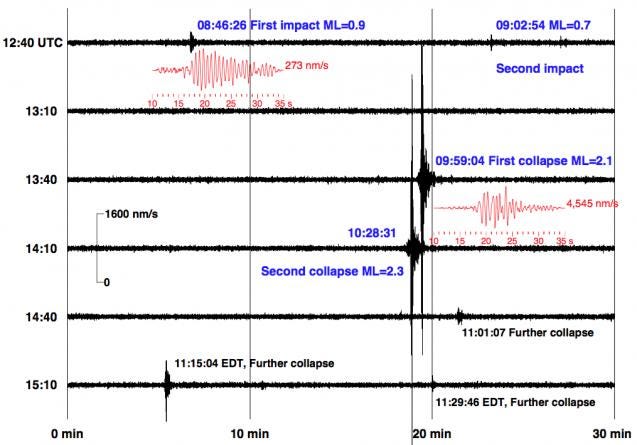
The seismic estimate was reported with an uncertainty of approximately + - 2 seconds. The 9/11 Commission Report’s time is 17 seconds later than the seismic estimate, so the discrepancy deserves examination of the underlying timing methods and records.
Three Official United 175 Impact Times
Lamont-Doherty seismic analysis - 9:02:54 a.m.
NIST’s commonly cited impact time - 9:02:59 a.m.
9/11 Commission Report - 9:03:11 a.m.
Lamont-Doherty Earth Observatory
One important qualification: seismic instruments record waves that travel through the ground, not the aircraft impact directly. Researchers calculate the event time by accounting for that travel time. The comparison therefore needs to distinguish the estimated time of impact from the time a seismic signal arrived at the recording station.
The primary research reference is Kim and Baum, Seismic Observations During September 11, 2001, Terrorist Attack, which sets out the seismic timing and methodology.
In principle, the seismic waves would have arrived at the recording station after the impact occurred, however, there is an important distinction. If the reported time of 9:02:54 a.m. is already the calculated of the impact time, rather than the time the seismic waves reached the instrument.
Here’s how the process works:
Impact: United 175 strikes the South Tower.
Wave propagation: The impact generates seismic waves that travel through the ground.
Recording: A seismic station detects those waves several seconds later, depending on the distance and wave velocity.
Time calculation: Researchers estimate when the original event occurred by accounting for the travel time.
If it is the recorded arrival time, the actual impact must have occurred earlier.
If it is the travel-time-corrected origin time, it already estimates the time of impact.
This distinction is crucial, because the 9/11 Commission gives 9:03:11 a.m. as the impact time. If the seismic figure is a corrected origin time, the difference is 17 seconds; if it is an arrival time, the comparison is different.
Therefore, 9:02:54 a.m. timestamp represents the calculated time of the signal, with a tolerance of + or - 2 seconds.
National Institute of Standards and Technology (NIST)
NIST stated the recorded the impact of United 175 at 9:02:59 a.m., differing by 5 seconds compared to the seismic reading data, and 12 seconds compared to the stated time by 9/11 Commission Report (9:03:11 a.m.). NIST's analysis distinguishes between the relative time obtained from visual evidence, the adjusted time assigned to the video timeline, and the seismic estimate.
Source: [Final Report on the Collapse of the World Trade Center Towers, NCSTAR 1, Chapter 3, section 3.2] https://nvlpubs.nist.gov/nistpubs/Legacy/NCSTAR/ncstar1.pdf
NIST’s time of 9:02:59 is 5 seconds later than the seismic readings, due to its relative visual timeline, which is explained by comparison of four independent television recordings and found a five-second difference from the time assigned in its initial database. Source: https://nvlpubs.nist.gov/nistpubs/Legacy/NCSTAR/ncstar1-5av1.pdf
[visual evidence, damage estimates, and timeline analysis (chapters 1-8]
Why did the Commission use a later time?
The 9/11 Commission explains its method in footnote 130 of its report. It notes that former NORAD official Alan Scott testified that the impact occurred at 9:02 a.m., but says its own analysis of FAA radar data and air traffic control software logic established the time as 9:03:11 a.m.
“We have determined that the impact time of United 175 was 9:03:11 based on our analysis of FAA radar data and air traffic control software logic.”
The published official explanation does not, by itself, establish why the 9/11 Commission's calculation differed from the seismic estimate by 17 seconds and 12 seconds from the seismic readings data. https://www.911commission.gov/report/911Report_Notes.htm
Why would the Commission's calculation differ?
Radar data can establish the last observed position of an aircraft, but the timestamp of a radar return is not necessarily identical to the instant of physical impact. To accurately determine the impact time from radar, investigators would need to understand the recording timestamps, radar update intervals, data processing and the relationship between the final tracked position and the building. The 9/11 Commission's footnote identifies its method in broad terms, but the cited statement does not explain precisely how those factors produced 9:03:11 a.m.? However, the discrepancy becomes more specific when we examine the 9/11 Commission's own hearing record.
At the 17 June 2004 hearing, Commission counsel John Azzarello stated: “At 9:03 and two seconds, United 175 crashed into the South Tower.” That’s 9:03:02, nine seconds earlier than the 9:03:11 timestamp in the final report.
Source: https://www.911commission.gov/archive/hearing12/9-11Commission_Hearing_2004-06-17.htm
The evidence so far establishes that the 9/11 Commission's 9:03:11 a.m. time does not establish why its calculation differs from the hearing transcript or NIST's time and the seismic data readings.
Why the 9/11 Commission timeline discrepancy exits
I am going to offer additional “official” evidence as to why I believe the time discrepancy exists, and why the 9/11 Commission has essentially ignored the other sources of crash times, and the dilemma the 9/11 Commission faced, which is why they had to state a later timeline of 9:03:11 a.m.
The Peter Hanson Phone Call Time Dilemma
Peter Hanson was allegedly aboard United 175, and he called his father twice. The first call was 10 minutes after the “alleged” hijacking at 8:52:00 a.m. Source: FBI TP 18 (Tampa Office). September 12, 2001 (Case ID 265D-TP-280350)
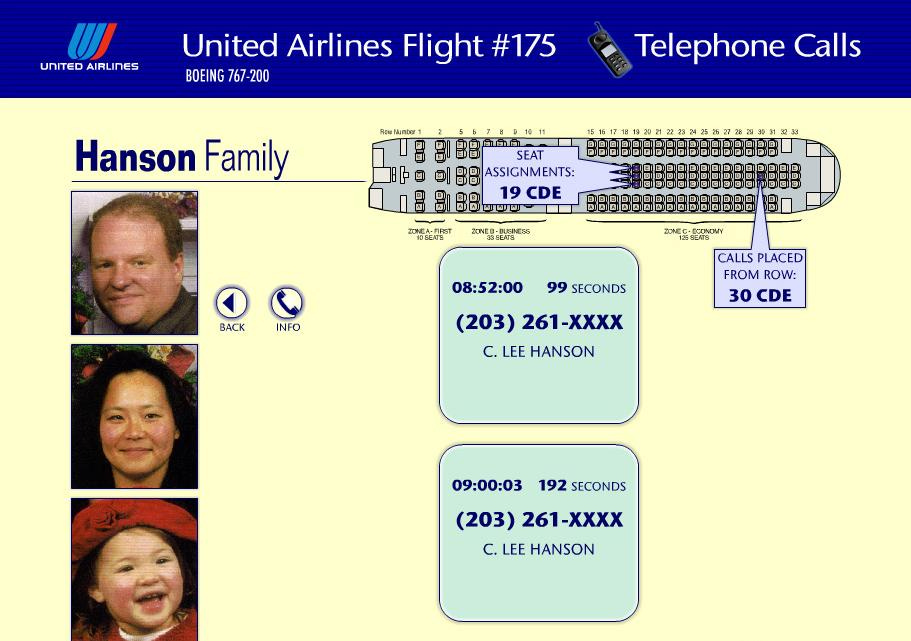
Peter Hanson’s second call was made at 9:00:03 a.m., which lasted 192 seconds, meaning Hanson’s phone call lasted until 9:03:15 a.m. This is a discrepancy of 4 seconds after the 9/11 Commission’s stated crash time of 9:03:11 a.m.
With Hanson’s phone call ending at 9:03:15 a.m., it obviously posed the 9/11 Commission a dilemma, taking into consideration that two different “official” sources state the crash time as 9:02:54 a.m. and 9:02:59 a.m. Also a conflicting element was at the 9/11 Commission hearing, which stated that the crash time was 9:03:02 a.m., 13 seconds before Hanson’s phone call ended. This would mean the 9/11 Commission had to revise the crash time nearer to the end of Hanson’s phone call to minimise the discrepancy, which would also make it easier to be passed-off with time recording variations of data collection. It would have been much more challenging for the 9/11 Commission to explain away the “official” seismic data reading crash time, or NIST’s stated time of the crash, making the time amendment by the 9/11 Commission essential to prop up their official narrative.
It is not the first time the 9/11 Commission has gone against the official seismic reading data. They also did this with United 93, which seismic reading showed United 93 to have crashed at 10:06 a.m., and not 10:03 a.m., as I outlined in my article linked here - https://911planesresearch.substack.com/p/how-the-911-commission-rewrote-the
The 9/11 Commission’s treatment of United 175’s “alleged” crash time, is a damming indictment against them.
It also opens up the question how Hanson’s phone call was able to keep connected after United 175 had “allegedly” crashed. The 9/11 Commission had to deal with Hanson’s phone call timeline dilemma by revising United 175’s crash time.
Finally, I will be addressing Hanson’s phone calls directly in a future article.
Thanks for reading, and still caring!
Great article, and research as alway Mark, thank you!
I'd like to, if I may, suggest some additional reading, and viewing...
Illusion of Reality and the 9/11 Planes
Is seeing believing, or believing seeing on 9/11?
Article: https://911planesresearch.substack.com/p/illusion-of-reality-and-the-911-planes
Podcast with Jerm Warfare: https://rumble.com/v646fsm-jerm-warfare-talks-to-911-planes-research.html
What if the central experiment in a study claiming to distinguish “manual” from “automated” flight never actually tested the aircraft it was supposed to investigate?
Why the “Manual or Automated?” Study Is Fundamentally Flawed
An Independent Analysis by 9/11 Planes Research
Article: https://911planesresearch.substack.com/p/why-the-manual-or-automated-study
A 9/11 "crash course", that covers all three sites.
Watch: 9/11 Alchemy - Facing Reality
Rumble Link: https://rumble.com/v42pr22-911-alchemy-facing-reality.html
Thank you, Mark!